
Gift season is coming, which means batteries are on my wish list. Not for Christmas, exactly. I would like fewer of them showing up in our garbage.
My family’s actual wish list includes earbuds for my son and cordless tools for us, all of which mean new batteries coming in. Meanwhile, when fall cleaning our home we rediscovered a drone, a remote-control dragon, the robotic vacuum, an electric toothbrush, old tool batteries, power banks and several beloved phones from our junk-drawer museum. We were impressed by our archive and now we’ve seen it, we’re ready to let go. Which means batteries to go out.
Many of those products contain lithium-ion (Li-ion) batteries. They pack a lot of energy into a small space, which is very useful, but they must be taken care of properly. If a battery is damaged, overheated or improperly charged it can overheat, catch fire or explode (Health Canada, 2026).
This isn’t just theoretical. In March, at a Saskatoon battery and phone store a faulty e-bike battery ignited in a testing area. The fire caused an estimated $1.5 million in damage and crews spent more than 16 hours extinguishing hot spots (Kozroski, 2026).
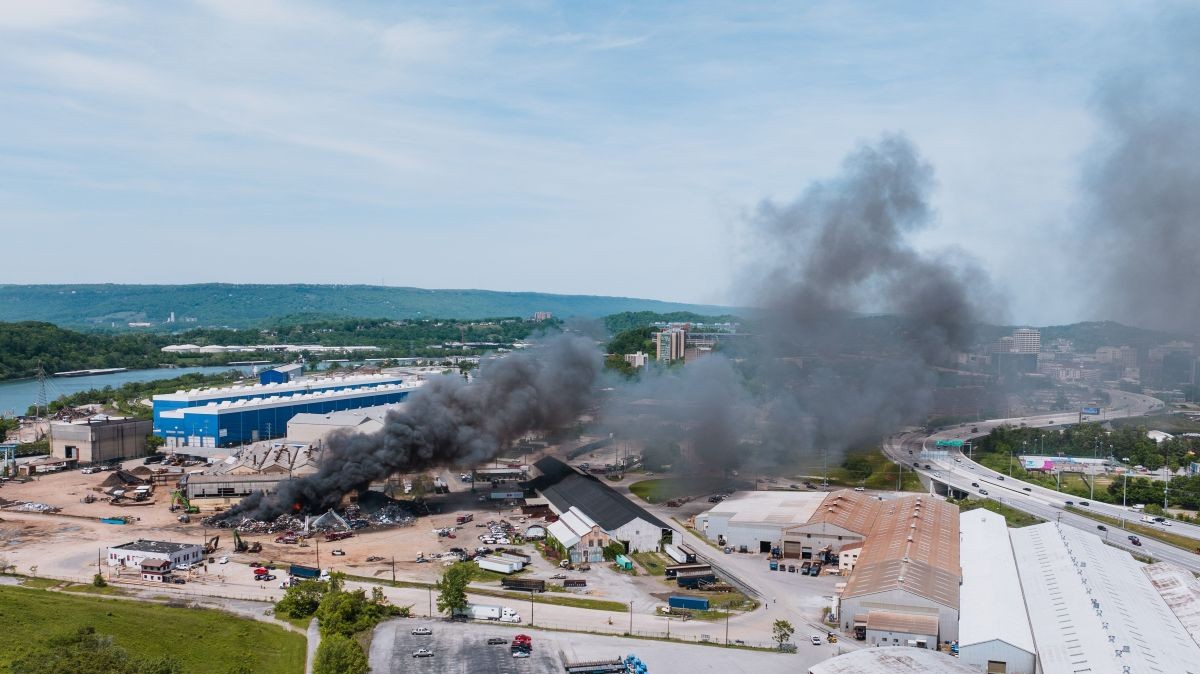
Batteries are also turning up where they really don’t belong: our waste stream. This year, officials pointed to Li-ion batteries as known, likely or suspected causes of fires at waste facilities in St. John’s, Newfoundland and Labrador; Kentville, Nova Scotia; and Hope, British Columbia (CBC News, 2026; Hauck, 2026; MacDonald, 2026).
So, how does a battery set garbage on fire?
Imagine a battery hidden in a bag of garbage going into a collection truck. The truck compacts its load. The battery gets crushed or punctured and can short-circuit. In some circumstances, that damage can trigger thermal runaway, a chain reaction where increasing temperature drives more heat and chemical reactions. Research has identified improperly discarded lithium batteries as an ignition risk during waste collection and processing (Nigl et al., 2021).
One interesting wrinkle is that the amount of charge matters. Researchers at Cranfield University crushed and damaged cells recovered from disposable vapes to simulate waste-processing conditions. Cells at 50% charge or less reached a maximum of 131°C but did not generate enough heat to ignite the common waste materials tested (Gausden & Cerik, 2024).
That doesn’t mean half-charged batteries belong in the garbage. It does remind us that batteries aren’t all equally hazardous and that maximizing the useful life of a product before responsibly recycling it is a good place to start.
Good news: Saskatchewan already has a system
In Saskatchewan, Recycle Your Batteries, Canada! operated by Call2Recycle, accepts eligible single-use and rechargeable batteries weighing less than five kilograms. There are more than 170 collection locations in the province, including all SARCAN depots (Recycle Saskatchewan, n.d.).
Electronics, both corded and battery operated, are covered by Saskatchewan’s electronics recycling program and have a recycling route through the Electronic Products Recycling Association. More good news, the program is getting bigger: beginning February 1, 2027, Saskatchewan is expanding regulated electronics to include products such as small appliances, power tools and outdoor power equipment (Electronic Products Recycling Association, 2026).
This is great news for my robotic vacuum. Less great for my procrastination on the weekends.
The real problem: remembering
Most people reading a waste-reduction blog probably already know batteries shouldn’t go in the garbage. My problem isn’t knowing. It’s having a system that works when I’m standing in the kitchen holding a dead battery.
So I’m making one.
At home, we’ll have a better designated spot for used batteries and another for old electronics, somewhere convenient but away from children. Instead of letting batteries migrate into junk drawers and the basement indefinitely, we’ll return them when we make our regular SARCAN trip.
When the bottles go to SARCAN, the batteries come too.
The goal isn’t just recycling more batteries. It’s keeping them out of garbage trucks and waste facilities as well.
Make it the first gift you give yourself:
Before the new drill, earbuds or electronic toy comes home this holiday season, figure out where its battery will eventually go.
Maybe even tackle your junk drawer.
I’m tackling mine. Although the remote-control dragon may be staying.
Claire Amundsen, P. Eng.
References
CBC News. (2026, June 15). St. John’s dump fire, likely started by lithium-ion battery, put out by bulldozers dumping gravel. https://www.cbc.ca/news/canada/newfoundland-labrador/robin-hood-dump-fire-9.7235480
Electronic Products Recycling Association. (2026, October 1). Steward update: October 1, 2026. https://arpe.ca/wp-content/uploads/2026/10/English-Newsletter-Web-Content-October-1-2026.pdf
Gausden, A., & Cerik, B. C. (2024). Single-use vape batteries: Investigating their potential as ignition sources in waste and recycling streams. Batteries, 10(7), 236. https://doi.org/10.3390/batteries10070236
Hauck, J. (2026, August 28). Garbage fire in Hope likely caused by lithium-ion battery. Hope Standard. https://www.hopestandard.com/2026/08/28/garbage-fire-in-hope-likely-caused-by-lithium-ion-battery/
Health Canada. (2026, September 29). Lithium-ion battery safety. Government of Canada. https://www.canada.ca/en/health-canada/services/household-products/battery-safety/lithium-ion.html
Kozroski, A. (2026, March 16). E-bike battery cause of $1.5M blaze at Saskatoon store. CBC News. https://www.cbc.ca/news/canada/saskatchewan/e-bike-battery-fire-store-9.7131176
MacDonald, M. (2026, July 31). Improper battery disposal blamed for fire at Nova Scotia waste and recycling facility. The Canadian Press. https://globalnews.ca/news/12005284/nova-scotia-waste-facility-fire-lithium-ion-batteries/
Nigl, T., Baldauf, M., Hohenberger, M., & Pomberger, R. (2021). Lithium-ion batteries as ignition sources in waste treatment processes: A semi-quantitative risk analysis and assessment of battery-caused waste fires. Processes, 9(1), 49. https://doi.org/10.3390/pr9010049
Recycle Saskatchewan. (n.d.). Battery recycling in Saskatchewan. https://www.recyclesaskatchewan.ca/call2recycle
